
9 Rock Musicians Whose Lyrics Became Cultural Touchstones
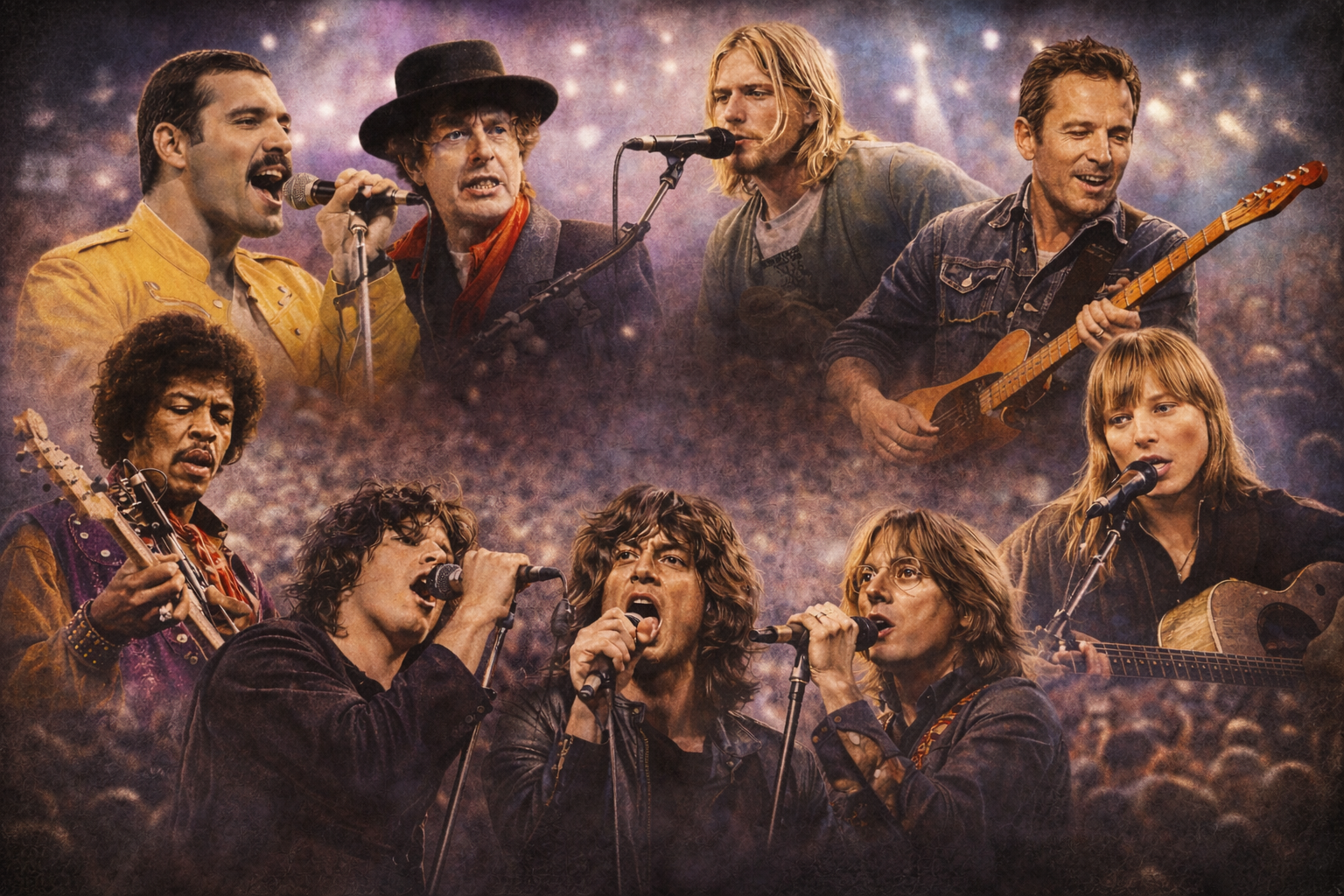
Great rock music doesn’t just fill arenas — it infiltrates everyday language. It sneaks into political speeches, high school yearbooks, graduation caps, protest signs, tattoos, and car rides with the windows down. When lyrics cross that boundary, they become more than art; they become cultural touchstones.
Some rock musicians didn’t just make hits — they minted phrases, philosophies, and emotional shortcuts that generations still quote without even knowing their source.
Here are the artists whose words outgrew their albums.
1. Bob Dylan — The Poet Laureate of Ambiguity
Dylan is the closest thing rock has to a literary canon. His lyrics aren’t just quoted — they’re analyzed, debated, and taught in humanities classrooms.
Touchstone lines include:
- “The times they are a-changin’.”
- “You don’t need a weatherman to know which way the wind blows.”
- “He not busy being born is busy dying.”
Dylan’s influence isn’t about clarity — it’s about metaphor. He gave generations vocabulary for political change, existential angst, and counterculture rebellion.
2. Bruce Springsteen — The Chronicler of the Working Class
Springsteen’s lyrics became shorthand for the American experience — the version beyond campaign slogans and tourism brochures.
Lines like:
- “It’s a town full of losers, and I’m pulling out of here to win.”
- “I believe in the love that you gave me, I believe in the faith that can save me.”
- “Is a dream a lie if it don’t come true, or is it something worse?”
These weren’t just songs; they were sociology. Springsteen articulated the hopes, disappointments, and daily dignity of people rarely centered in pop culture. His words became part of the national vocabulary about identity and aspiration.
3. Joni Mitchell — The Philosopher of Feeling
Joni didn’t write lyrics for t-shirts; she wrote lines that people quietly carry through breakups, healing, parenthood, and self-discovery.
Her most-quoted lines tend to emerge at emotional inflection points:
- “Don’t it always seem to go that you don’t know what you’ve got ’til it’s gone?”
- “I’ve looked at life from both sides now.”
- “We are stardust, we are golden.”
Mitchell gave cultural voice to introspection, vulnerability, and self-examination long before those ideas were mainstream.
4. John Lennon — The Idealist Whose Phrases Became Banners
Even outside his Beatles years, Lennon minted slogans that the culture seized on — sometimes sincerely, sometimes ironically.
From “Imagine” alone, you get:
- “Imagine all the people…”
- “Nothing to kill or die for.”
- “You may say I’m a dreamer…”
These lines became banners for peace movements, humanitarian causes, and every person who ever wished the world made more sense.
5. Freddie Mercury & Queen — The Universal Anthem Makers
Queen lyrics don’t just get quoted — they get shouted, stamped on banners, and sung in stadiums across generations.
Culture took ownership of lines like:
- “We are the champions.”
- “Another one bites the dust.”
- “I want to break free.”
- “Don’t stop me now.”
Queen mastered something rare: lyrics that are both personal and universally adaptable. They became the soundtrack to sports wins, personal milestones, and collective celebrations.
6. Kurt Cobain & Nirvana — The Grunge Chroniclers of Alienation
Cobain’s influence isn’t about clear messaging — it’s about the shared feeling of not fitting in.
Even people who never owned a flannel have heard:
- “Here we are now, entertain us.”
- “I miss the comfort in being sad.”
His lyrics gave voice to the exhaustion, irony, and numbness of the 90s youth — a cultural mood that still echoes in modern alt and Internet culture.
7. Bono & U2 — The Diplomat Poets
U2 lyrics ended up on political stages, church walls, aid campaigns, and TED Talks long before memes existed.
Most recognizable touchstones:
- “All is quiet on New Year’s Day…”
- “I still haven’t found what I’m looking for.”
- “One love, one life…”
They merged rock with spiritual reflection and geopolitical awareness, making U2 the band of both stadiums and policy conferences.
8. Patti Smith — The Punk Prophet
Patti Smith is less mainstream than most on this list, but her lines circulate within subcultures with near-religious reverence.
From People Have the Power to Horses, she minted phrases that became rallying cries for artists, feminists, activists, and outsiders.
Her words weren’t designed to be pretty — they were designed to move.
9. David Bowie — The Patron Saint of Self-Reinvention
Bowie’s lyrics became cultural shorthand for fluid identity, futurism, and self-invention.
Consider:
- “We can be heroes, just for one day.”
- “Turn and face the strange.”
- “There’s a starman waiting in the sky.”
Those concepts didn’t just soundtrack the LGBTQ community, art kids, fashion movements, and futurists — they helped define them.
Why These Lyrics Endured
What separates these musicians from thousands of other rock lyricists?
They wrote words that became:
- philosophies (“The times they are a-changin’”)
- identities (“I want to break free”)
- protest signs (“People have the power”)
- self-descriptions (“We are stardust, we are golden”)
- emotional compressors (“I still haven’t found what I’m looking for”)
- communal chants (“We are the champions”)
At some point, the lines stopped belonging to the musicians who wrote them. They became linguistic tools everyday people used to express their own meaning.
That’s the moment lyrics become cultural touchstones.

![20 Inspiring Children’s Book Quotes [Infographic]](https://cdn.sanity.io/images/fffw1m6f/production/0ba45984dd1a7010395da8e8b34685ae8d88a6c3-5120x2880.jpg?auto=format)
![40 Unforgettable Birthday Quotes [Infographic]](https://cdn.sanity.io/images/fffw1m6f/production/ea0241e55e13346b3aca816b5dfae0f8cf703656-5120x2880.jpg?auto=format)