He clasps the crag with crooked hands;
Close to the sun in lonely lands,
Ringed with the azure world, he stands.
The wrinkled sea beneath him crawls;
He watches from his mountain walls,
And like a thunderbolt he falls.
About This Quote
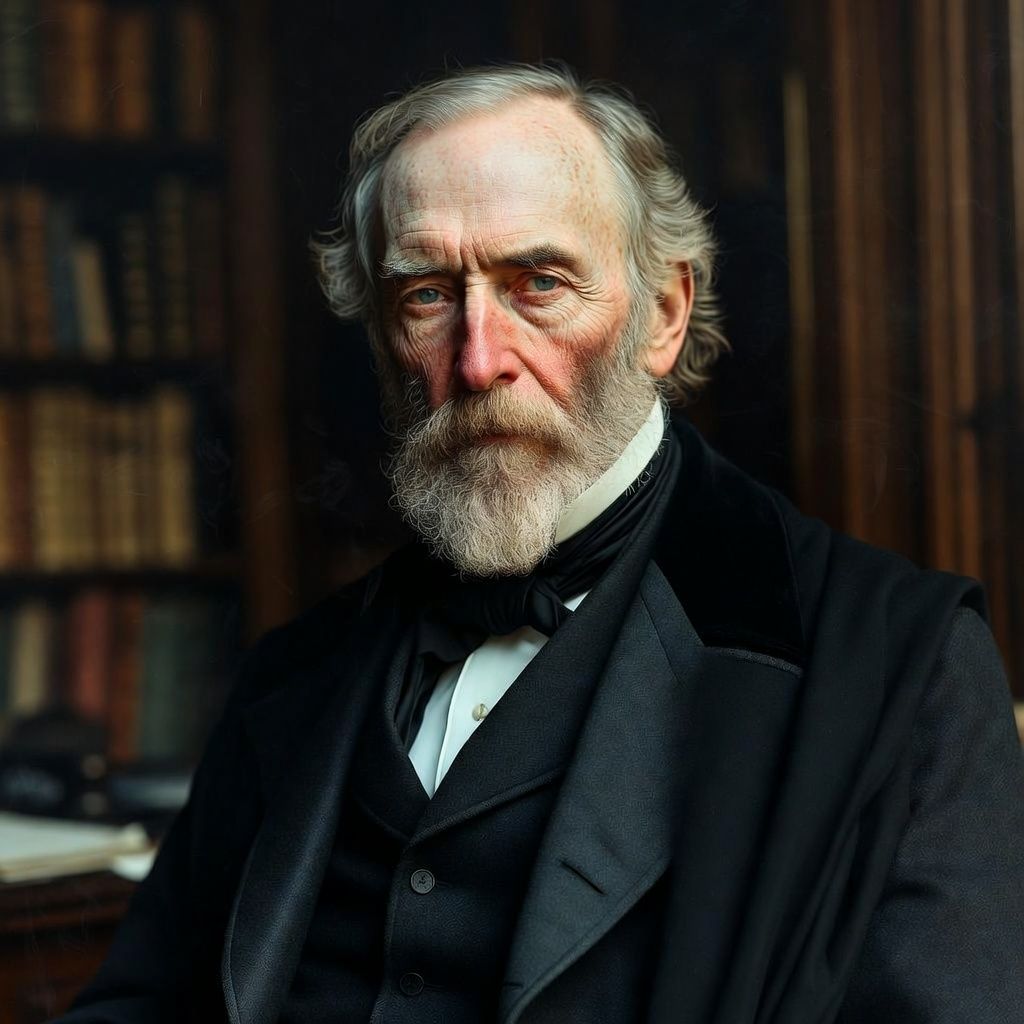
These lines are from Alfred, Lord Tennyson’s short lyric “The Eagle,” first published in 1851. Written in the high Victorian period, the poem reflects Tennyson’s characteristic attention to vivid natural description and compressed, musical language. It appeared during his tenure as Poet Laureate (appointed 1850), when his work was widely read and frequently reprinted in periodicals and later collected editions. The poem is often treated as a miniature “nature study”: a single, intensely focused scene in which the eagle is observed at a great height, poised above sea and land, before its sudden dive.
Interpretation
Tennyson presents the eagle as a figure of solitary power and precision. The bird’s “crooked hands” (talons) anthropomorphize it while emphasizing its grasping strength; the “azure world” encircling it suggests both vastness and isolation. The sea “crawls” far below, shrinking the human-scaled world into something distant and slow, while the eagle’s stillness conveys controlled dominance. The final line—“And like a thunderbolt he falls”—turns poised majesty into sudden kinetic force, capturing the dramatic transition from watchful sovereignty to decisive action. The poem’s compact form mirrors its subject: concentrated energy released in an instant.
Source
Alfred, Lord Tennyson, “The Eagle” (first published 1851).